Fasting Fundamentals
Does Coffee Break a Fast?

Black coffee does not break a fast. A plain cup has about two calories, so it does not raise insulin in any meaningful way. In fact, in the lab it actually promotes the same fasted-state machinery you are aiming to switch on during a fast. That said, what you mix into your coffee is where you should use caution.
This is true for brewed coffee or espresso, hot or iced, caffeinated or decaf. Add-ins are a separate question, answered below.
The short answer
Black coffee is one of the few things nearly every fasting protocol agrees is fine. Whether you are doing 16:8, a 24-hour fast, or a longer one, plain coffee sits comfortably inside the fasted state. The two things to watch are not controversial: how much you drink, and what you put in your coffee.
The cleanest way to think about it is the framework from our pillar guide on what breaks a fast: whether something breaks your fast depends on your fasting goal, where what you consume is judged against three “gates.” Clear all three and the item in question is compatible with any fast, right up to a strict autophagy “clean fast.” Black coffee clears all three. But the most popular things people mix into their coffee block at least one gate, and this is where your goal starts to determine eligibility for those add-ins.
Why black coffee clears all three gates
The Three-Gate Test asks three separate questions of anything you consume during a fast: does it deliver calories, does it raise insulin, and does it trigger mTOR, the body’s main growth signal. Trip any one, in a meaningful amount, and you have broken the strictest kind of fast; whether you have broken your fast then comes down to your own personal fasting goal. Clear all three and the item is compatible with any fast. Black coffee passes all three.

Gate 1: calories
Plain brewed coffee is almost entirely water. The trace of dissolved solids from the beans works out to roughly two calories per eight-ounce cup,1 and even a large or strong brew lands in the single digits. Three cups across a morning is still under ten calories, far below the level that matters for any common fasting goal. Coffee clears the calorie gate with room to spare.
Gate 2: insulin
Insulin is the gate that matters most if your goal is metabolic, like fat-burning or ketosis. Black coffee contains essentially no carbohydrate, so there is no glucose to drive an insulin response the way food does. Inside a fasting window, with no food present, insulin simply stays flat. Coffee clears the insulin gate with flying colors.
Gate 3: mTOR
mTOR is the protein-and-growth gate, the one that matters if you are fasting for cellular cleanup (autophagy). mTOR responds mainly to amino acids and insulin. Coffee has no protein and no amino acids, so it never sends the “fed” signal that switches mTOR on. In fact it may do the opposite. In mice, both regular and decaffeinated coffee triggered autophagy within one to four hours, and did it by quieting the same mTOR signaling pathway.2 That is animal data, so it should be treated as suggestive rather than settled for humans, but it points in the same direction as fasting. The fasted state runs on low mTOR and high AMPK, the cell’s low-energy sensor, and black coffee sits comfortably on that side of the line. It clears the mTOR gate.
Does coffee affect ketosis or fat burning?
This is the second axis worth answering separately, because “fasting-compatible” and “good for ketosis” are not the same question. Here black coffee is neutral to mildly helpful. Caffeine is a known stimulant of lipolysis, the release of stored fat: in one controlled study it roughly doubled fat turnover and raised metabolic rate by about thirteen percent.3 Two caveats matter here: that study used a large dose of caffeine, closer to five or six cups than one, and most of the fat it mobilized is recycled rather than burned off. So if your reason for fasting is fat metabolism or staying in ketosis, coffee works in your favor. It will not put you into ketosis on its own, and it is not a fat-loss tool, but it does not reduce ketosis either.
Coffee, focus, and a clear head on an empty stomach
A lot of people fast partly for the mental clarity, and coffee is the obvious lever, with roughly ninety-five milligrams of caffeine in a typical cup. The catch is that caffeine on a truly empty stomach hits harder for some people: sharp focus turns into a jittery or wired mind state and then often a flat crash a couple of hours later. The fix most people reach for is not less coffee but better-balanced stimulation.
From Kētos
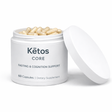
Coffee is only half the stack. On an empty stomach, caffeine can turn into jitters and even an energy crash. Core is the other half.
A synergistic combination of L-theanine, L-tyrosine and clinically studied SHR-5 Rhodiola designed to promote elevated clarity and produce calm, alpha-wave focus that smooths your coffee’s jitters and holds strong through a fasted morning.
Explore Core →What you add: the part that actually breaks the fast
Here is where most “did I break my fast” worry actually belongs. The coffee is fine. The splash of this and spoon of that is the real variable. The further right you go on the spectrum below, the more gates your fast stops clearing.

| What you add | Breaks a strict fast? | Reduces ketosis? | Bottom line |
|---|---|---|---|
| Nothing (black coffee) | No | No | The clean choice |
| Splash of unsweetened nut milk | Yes | No | Breaks a strict fast, but keeps you in ketosis |
| Splash of milk or cream | Yes | Slightly | A “dirty fast”; take it black for a strict one |
| Sugar (1 tsp) | Yes | Yes | Breaks it on calories and insulin |
| Sweetened or flavored creamer | Yes | Yes | Breaks the fast |
| MCT oil or butter (bulletproof) | Yes | No (deepens it) | Breaks a strict fast, keeps you in ketosis |
| Stevia or monk fruit (plant-based) | Probably not | No | Calorie-free, no insulin effect; fine for most goals |
| Sucralose or aspartame (artificial) | Possibly | No | Sucralose can nudge insulin; keep for your window |
Milk and cream
Even a small pour comes at a cost. Milk and cream carry calories and, more importantly for the fast, a little protein, which touches the mTOR gate. A real splash of cream can run thirty to fifty calories, a tablespoon of milk closer to ten. The protein in a splash that size is small, well under a gram, so the mTOR nudge is minor. The amounts are modest, but they move you off a clean fast. If your goal is simply getting to your eating window or keeping appetite down, a splash will not undo your morning. If your goal is autophagy or a true clean fast, stick to black coffee. Adding a little and accepting the trade-off is what people mean by dirty fasting.
Sugar and sweetened creamers
This is the clear line. Sugar is pure carbohydrate, so it fails the calorie gate and the insulin gate at once, and a single teaspoon is enough to register. Flavored syrups and sweetened creamers are sugar plus fat in one pour, often thirty to sixty calories or more. Both break the fast on every axis that matters. If you sweeten your coffee out of habit, this is the one change you’ll have to make.
Non-caloric sweeteners
It helps to split these into two groups. The plant-based ones, stevia and monk fruit, are calorie-free, sit at zero on the glycemic index, and in controlled studies do not raise blood glucose or insulin in healthy adults. They are the clean picks. The artificial ones, mainly sucralose and aspartame, are where it gets mixed, and sucralose is the one to watch: several trials found that a dose taken before a glucose load raised the insulin response compared with water,4 and pure sucralose also carries gut-microbiome question marks that the plant-based options do not.5
On calories, all of them pass in pure form, though branded packets often add a little dextrose or maltodextrin as bulking agent that nudges them off zero. There is also the cephalic phase insulin response, the small anticipatory insulin release triggered by sweet taste alone, which is real but modest and varies a lot from person to person.6 The practical read: if you want your coffee sweet, stevia or monk fruit are fine for most fasting goals; keep sucralose and other artificial sweeteners for your eating window; and for a strict fast or one aimed at autophagy, where the whole point is sending no “food is coming” signal at all, the safest move is plain black coffee.
Bulletproof and butter coffee
Bulletproof coffee, blended with MCT oil and butter, is the exception that confuses everyone, and it is the cleanest example of why two axes beat one. A serving is several hundred calories of almost pure fat, so on calories it clearly breaks a strict fast. But it has no protein to wake up mTOR and no carbohydrate to raise insulin, so it does not pull you out of ketosis. It can even push you deeper into ketosis, because unlike ordinary long-chain fats, the medium-chain fats in MCT oil are routed straight to your liver and converted directly into ketones, actively raising the level in your blood. That is the split verdict: it breaks a strict fast, but it does not reduce ketosis. If you are doing a fat fast or you mainly want appetite control while staying in ketosis, bulletproof coffee has a place. If you are fasting for autophagy or cellular cleanup, those calories end the fast, full stop.
How to drink coffee while fasting
Match the cup to the goal. The stricter the goal, the simpler the coffee.
- Autophagy or a clean fast: black coffee or plain espresso only, nothing added. Decaf counts too if you want the ritual without the caffeine.
- Metabolic or ketosis goals: black coffee is ideal, and a non-caloric sweetener is fine if you need it. Skip milk and sugar.
- Just hitting your eating window or managing hunger: black is still best, a splash of milk will not wreck it, and stevia beats sugar if you want it sweet.
- Dose and timing: one to three cups is plenty. Coffee hits harder on an empty stomach, so ease in if you get jittery, and keep your last cup earlier in the day so it does not cost you sleep. Stay on top of water and electrolytes as well, since coffee is mildly diuretic.
One more thing worth saying plainly: coffee is a useful tool, not a way to power through. If you are leaning on cup after cup to push past real hunger, fatigue, or brain fog, that is usually a signal to look at your sleep, your electrolytes, or your eating window, not to brew another pot.
The bottom line
Black coffee is fast-safe across the board: it has about two calories, doesn’t spike insulin, and actually gently nudges your metabolism toward the fasted state. Whether it breaks your fast comes down entirely to what you add and how strict your goal is. Take it black for the cleanest fast. The moment you add cream, sugar, or fat, you trade one of those gates away, and whether that trade is worth it depends entirely on the fast you are targeting. Black coffee was never the thing standing between you and your goal. What you stir into it is, and now you know exactly what each pour costs.
Key takeaways
- Plain black coffee, brewed or espresso, hot or iced, caffeinated or decaf, does not break a fast.
- It clears all three gates of the Three-Gate Test: roughly two calories per cup, no meaningful insulin response, and no protein to trigger mTOR.
- In animal studies, coffee triggered autophagy and lowered mTOR activity within hours, pointing in the same direction as fasting.
- Caffeine modestly raises fat burning and metabolic rate, so coffee is neutral to mildly helpful for ketosis and fat-loss goals.
- The add-ins are what break a fast: sugar and sweetened creamers break it outright; milk and cream break a strict fast; among non-caloric sweeteners, stevia and monk fruit are cleanest and sucralose is the one to watch; bulletproof coffee breaks a strict fast on calories but keeps you in ketosis.
- The stricter your goal, the more you should take it black.
References
- U.S. Department of Agriculture, Agricultural Research Service. FoodData Central: Coffee, brewed from grounds, prepared with tap water. (Approximately 2 kcal per 8 fl oz cup.)
- Pietrocola F, Malik SA, Mariño G, et al. Coffee induces autophagy in vivo. Cell Cycle. 2014;13(12):1987-1994.
- Acheson KJ, Gremaud G, Meirim I, et al. Metabolic effects of caffeine in humans: lipid oxidation or futile cycling? American Journal of Clinical Nutrition. 2004;79(1):40-46.
- Pepino MY, Tiemann CD, Patterson BW, Wice BM, Klein S. Sucralose affects glycemic and hormonal responses to an oral glucose load. Diabetes Care. 2013;36(9):2530-2535.
- Suez J, Cohen Y, Valdés-Mas R, et al. Personalized microbiome-driven effects of non-nutritive sweeteners on human glucose tolerance. Cell. 2022;185(18):3307-3328.
- Langhans W, Watts AG, Spector AC. The elusive cephalic phase insulin response: triggers, mechanisms, and functions. Physiological Reviews. 2023;103(2):1423-1485.
Filed under Fasting Fundamentals
These statements have not been evaluated by the Food and Drug Administration. This article is for educational purposes only and is not intended to diagnose, treat, cure, or prevent any disease. Consult a qualified healthcare professional before making changes to your diet, supplement routine, or fasting practice.